Age of Bacteria: a strategy game on an endless petri dish
Age of Bacteria is a game about a bacteria culture on an endless petri dish. You pick a species, tap a spot on the map and the culture starts to grow. From then on you keep it alive against rival colonies, seasons, famine and environmental disasters.
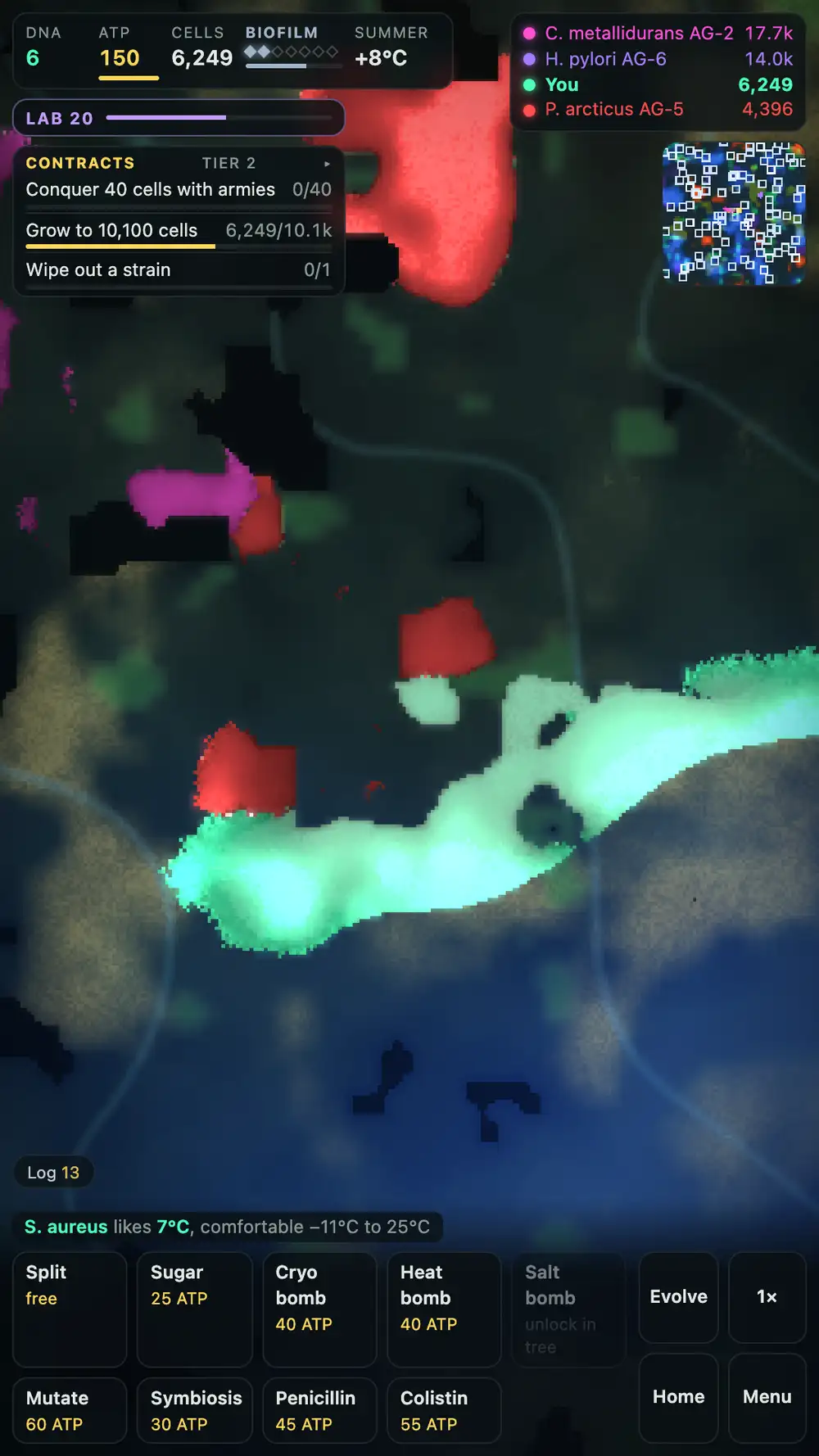
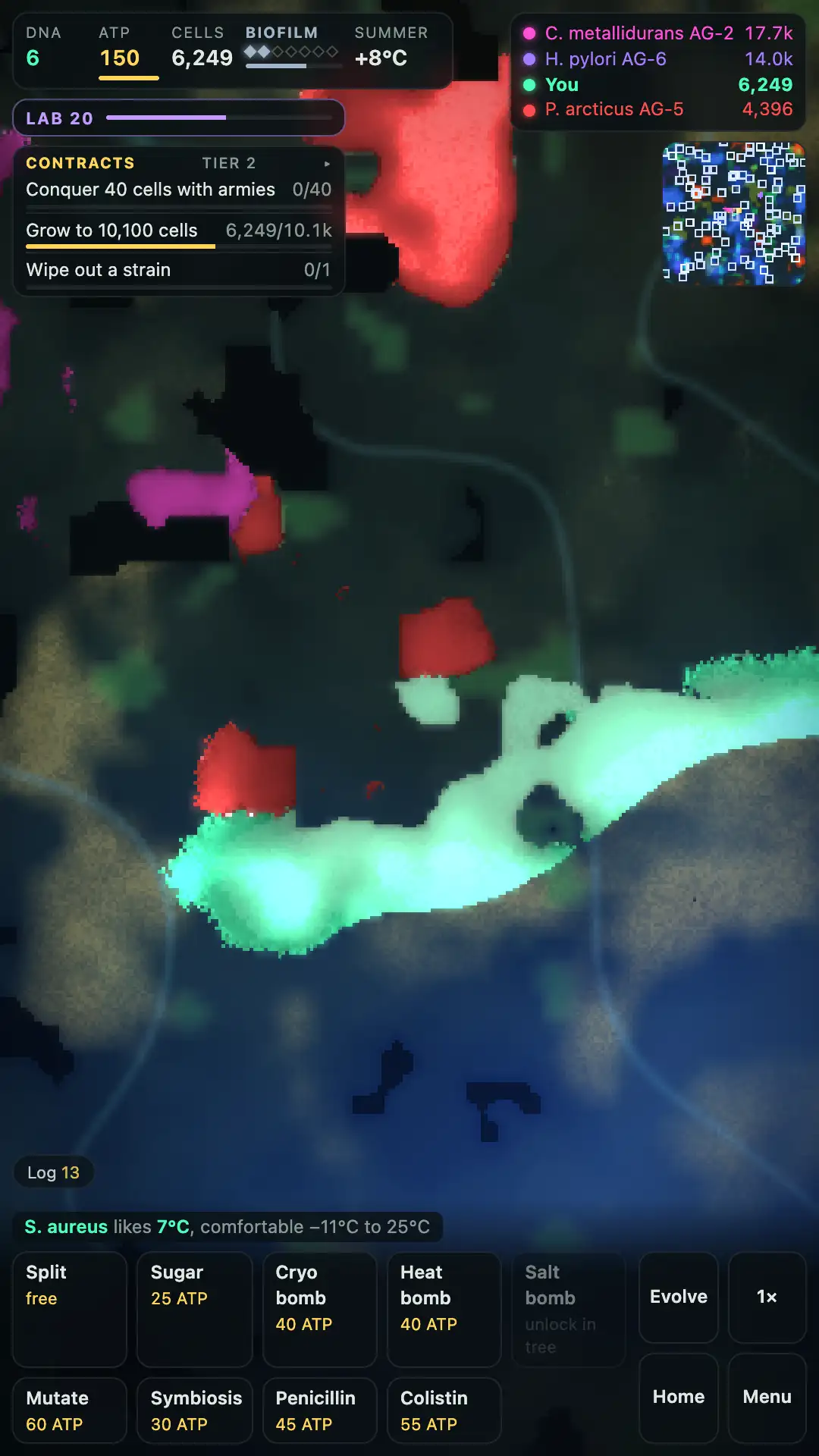
S. aureus against three rival strains 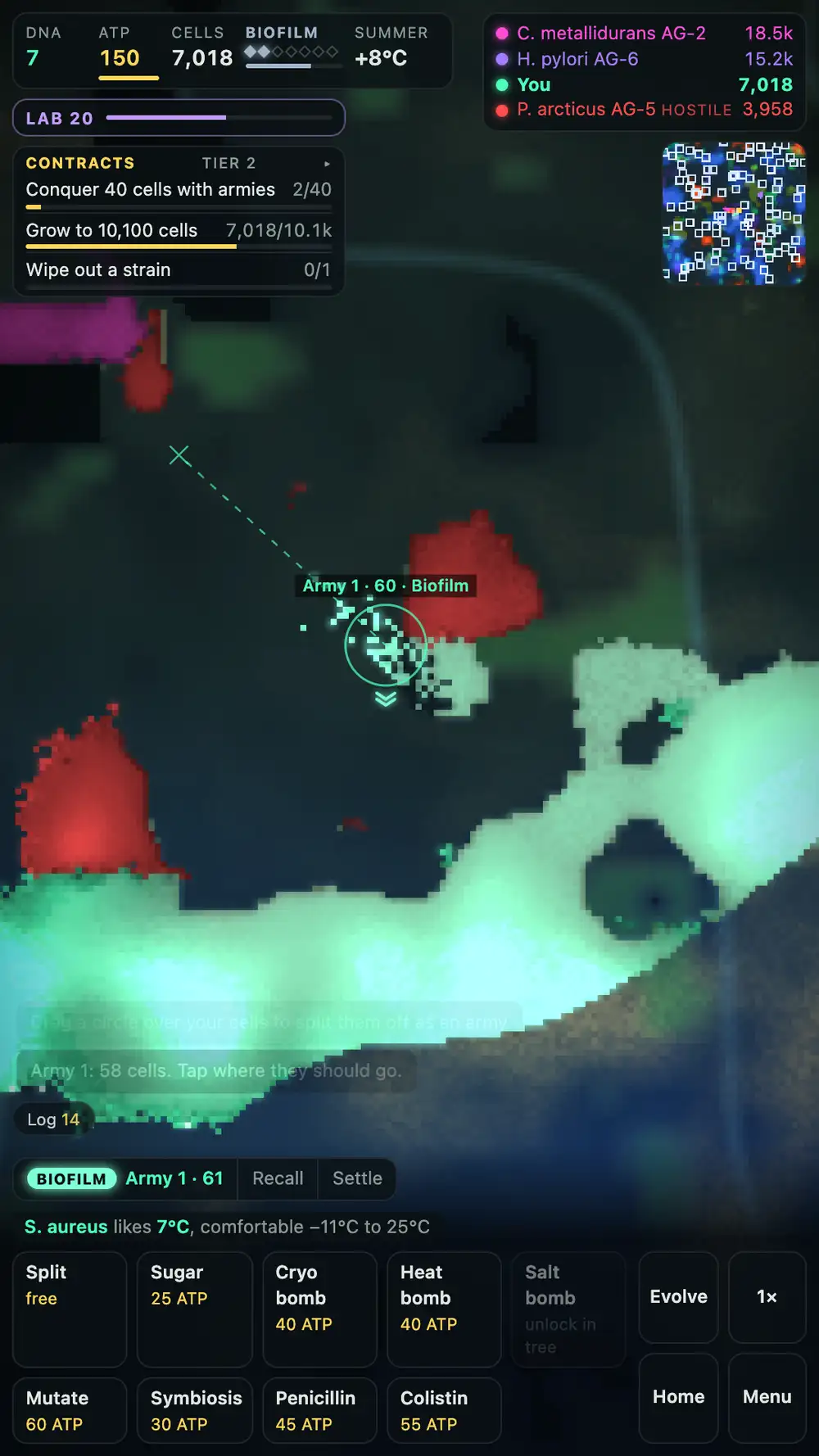
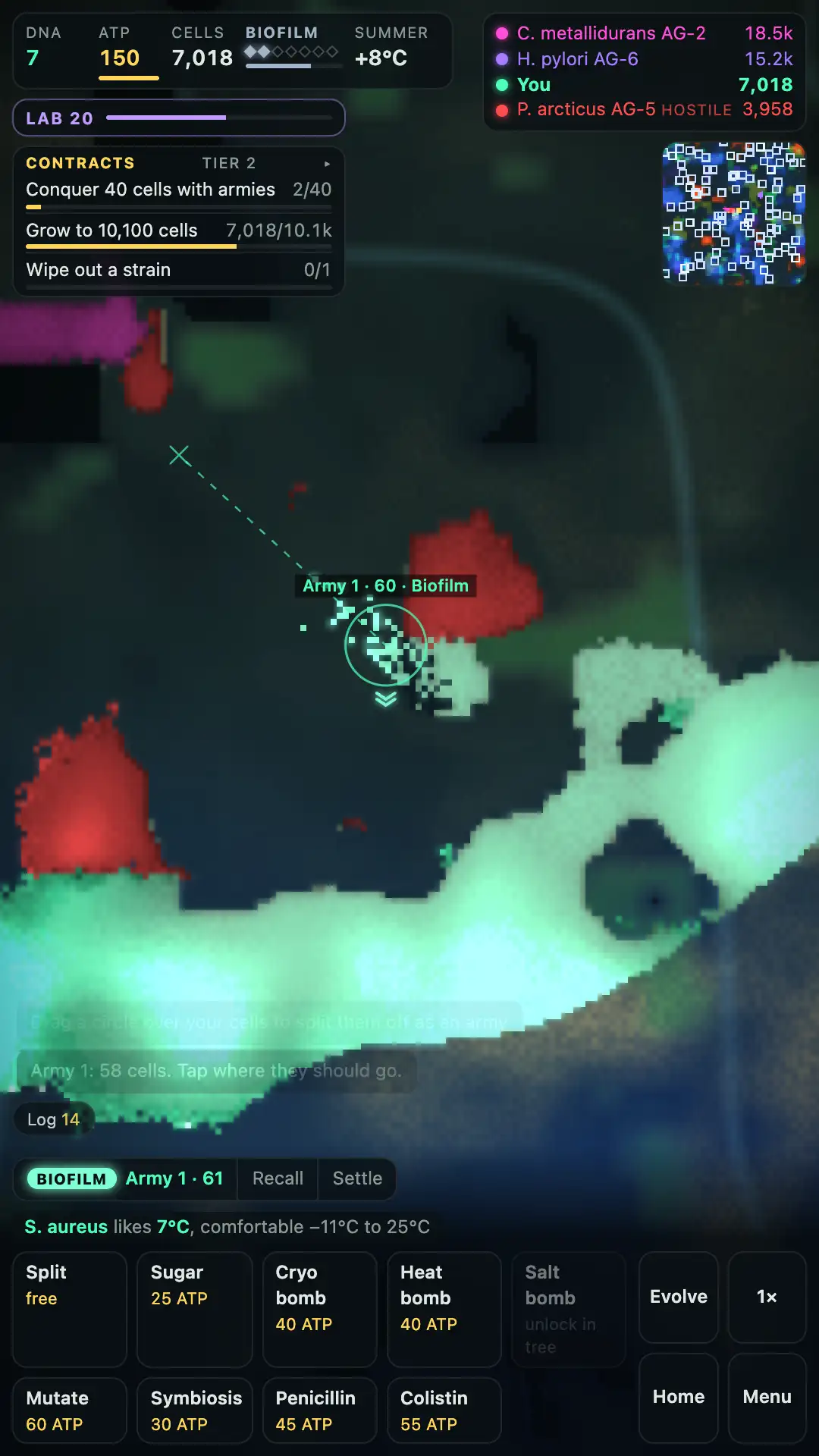
An army on its way to a rival 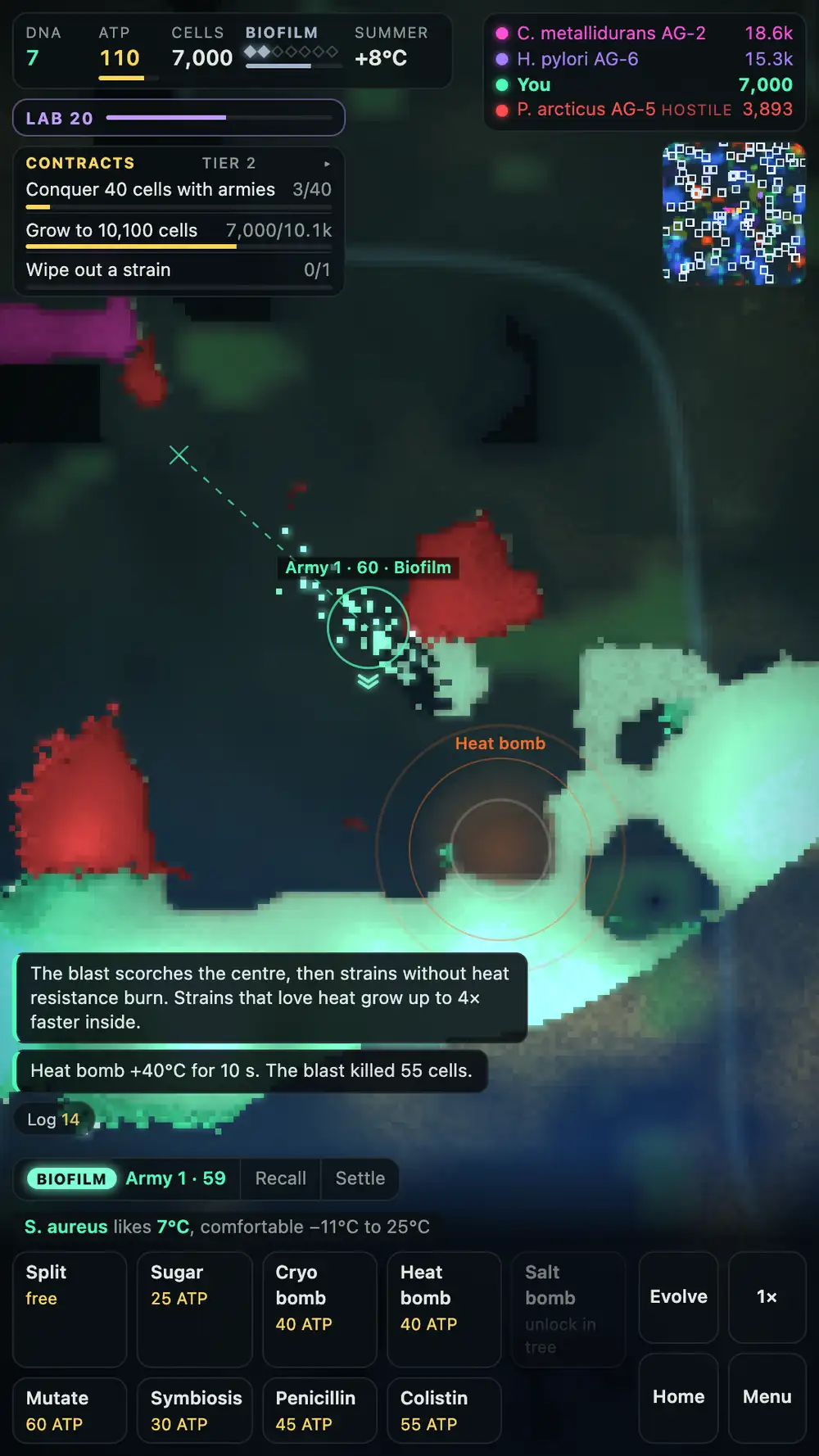
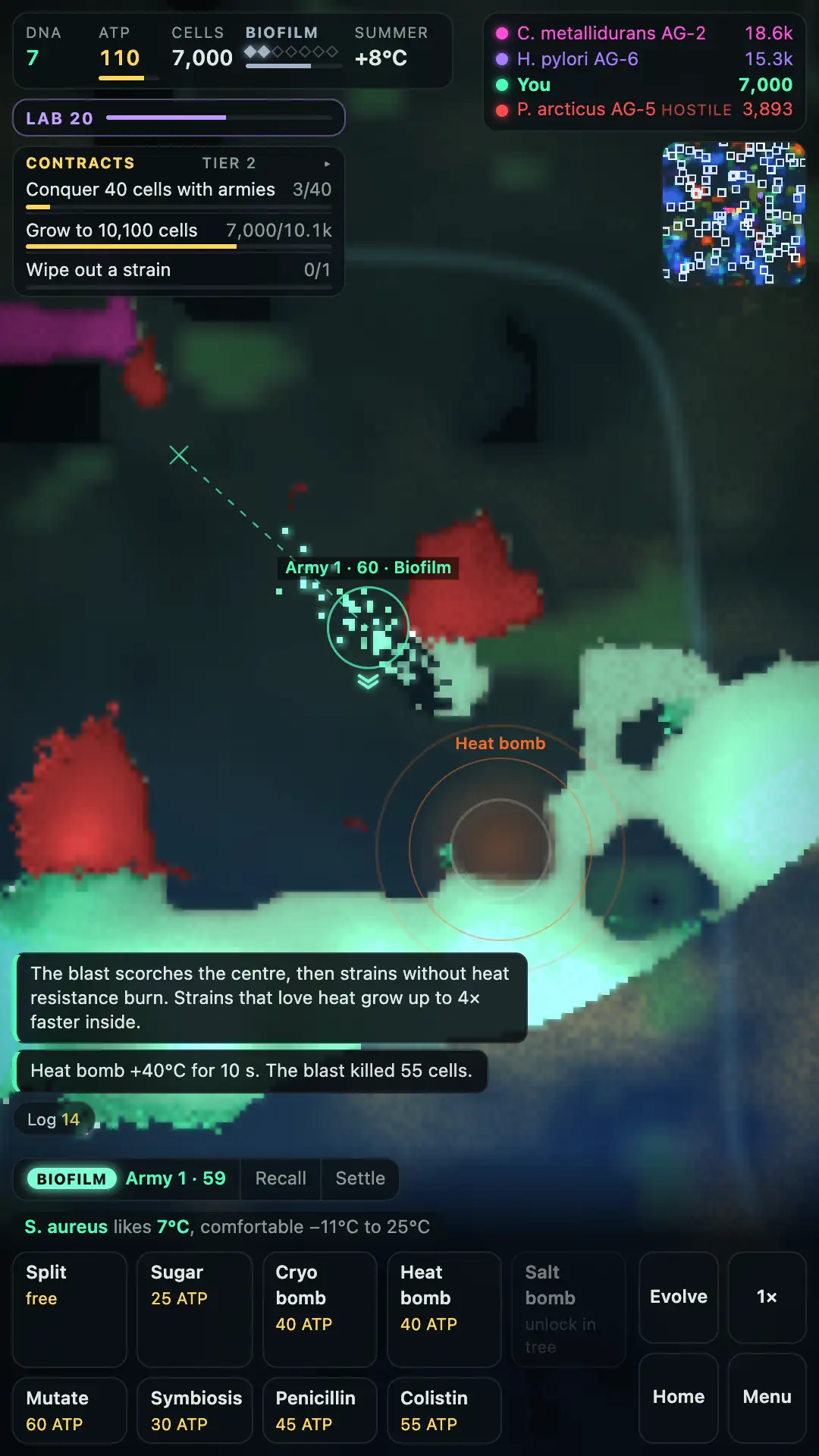
The heat bomb killed 55 rival cells 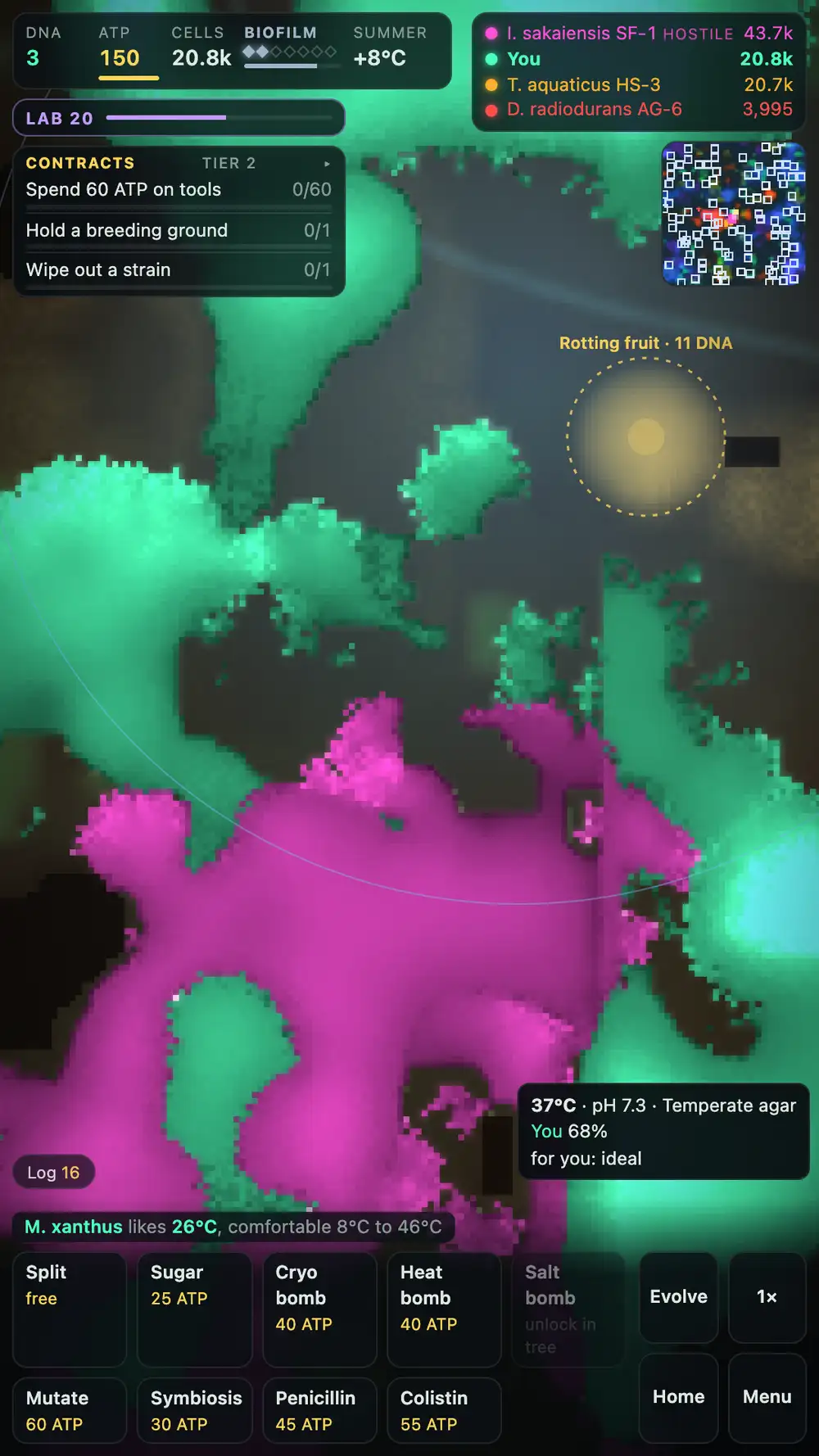
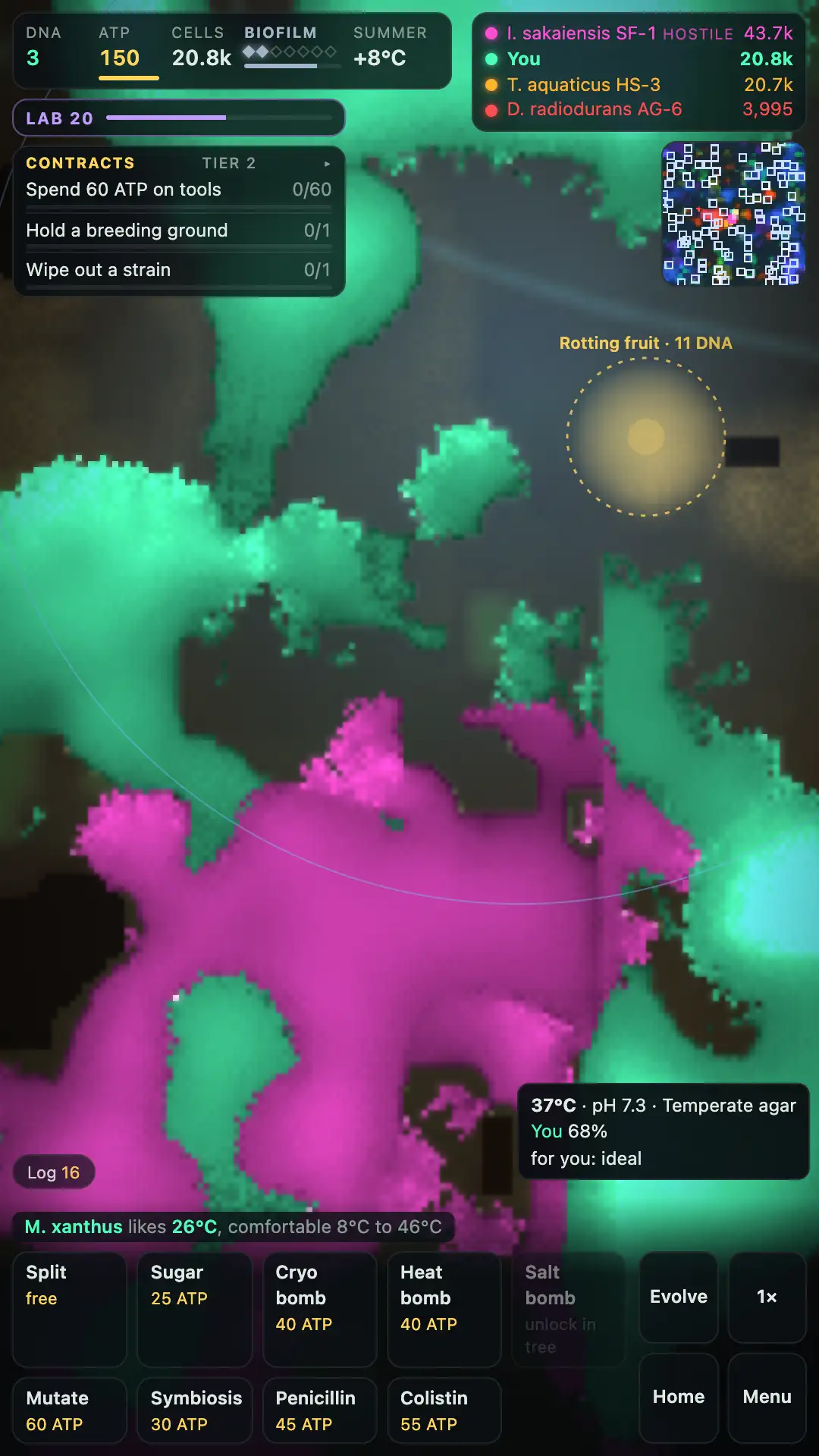
The front line against a plastic eater
Why bacteria
I like it when things grow. And I still haven’t got over the Game of Life: four rules about counting neighbours, and gliders walk across the grid without anyone telling them to.
The Game of Life is a zero-player game. You set up the grid, press start and watch. Age of Bacteria keeps the grid and hands you the controls. The cells still follow their own rules, you just get to push them around.
How a cell decides
Every tick, each living cell checks whether it is too hot, too cold or too acidic for it, eats, pays its upkeep and takes damage from pH, radiation and toxins. Then it picks a random neighbour. If that spot is empty, the neighbour gets half the cell’s energy and becomes a new cell. If it holds an enemy, the cell attacks. If it holds a weaker cell of its own strain, the cell passes energy over.
That is not many more rules than the Game of Life has, with energy in place of a neighbour count. The colony shapes and the fronts that move back and forth come out of them.
Cells eat sugar first and biomass second. On a rich sugar patch a colony grows explosively. Once it has eaten the patch faster than it regrows, starving cells burst and drain their neighbours, and famine runs through the colony like a wave.
What you do
Seasons shift the whole map by up to 10°C, so a border that was safe in spring can freeze solid in winter. Heatwaves and cold fronts sweep across, and from the sixth minute on medical treatment starts: a course of the antibiotic that hurts you most. Usually the right answer is to move out.
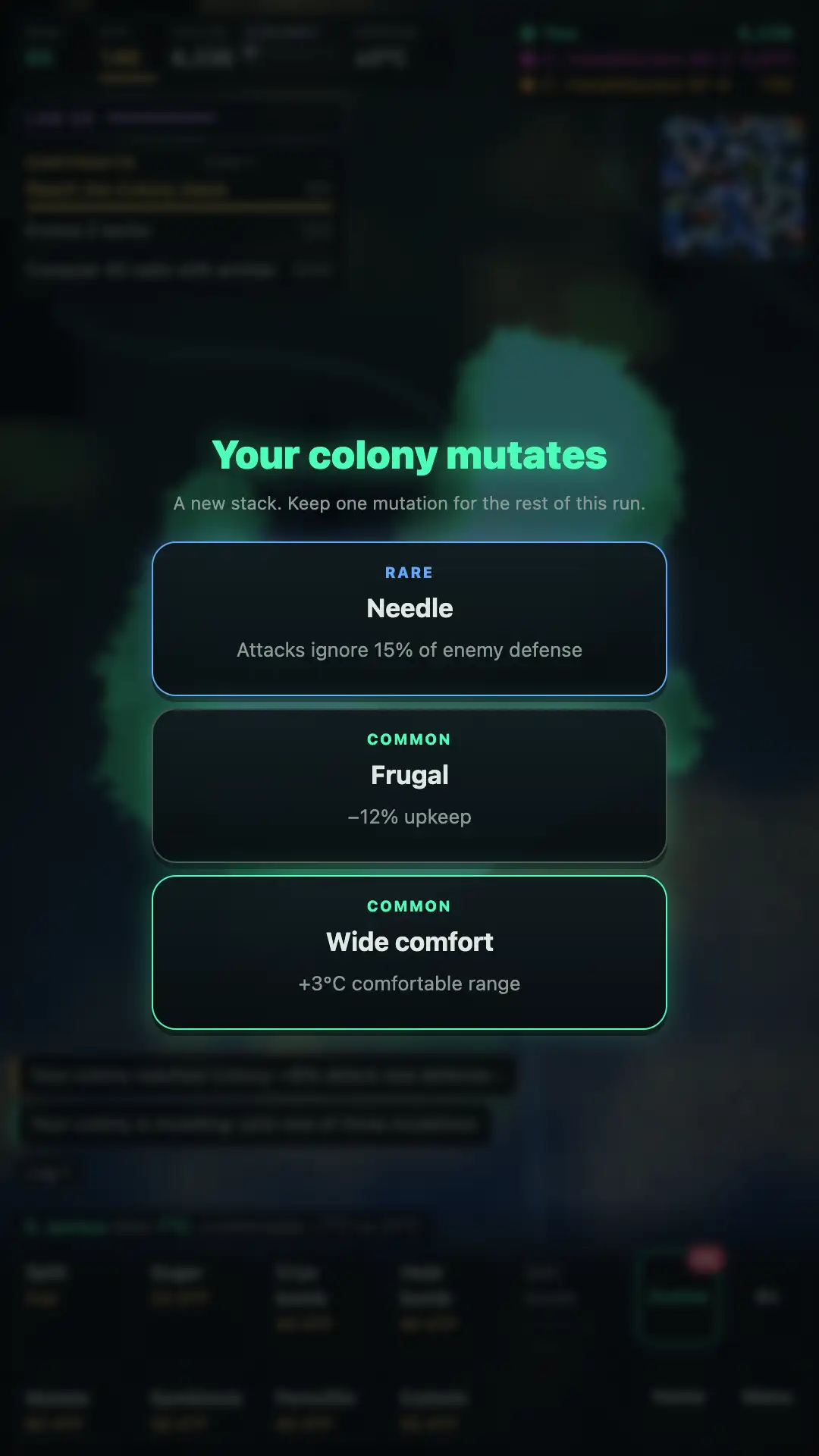
To move, you drag a circle over your cells and split them off as an army. Tap a target and the army marches there, fights whatever is in the way and settles. ATP pays for sugar drops, heat, cryo and salt bombs, forced mutations and antibiotics. DNA goes into the evolution tree. Every time the colony reaches a new stack, the game stops and offers three random mutations, and you keep one for the rest of the run.
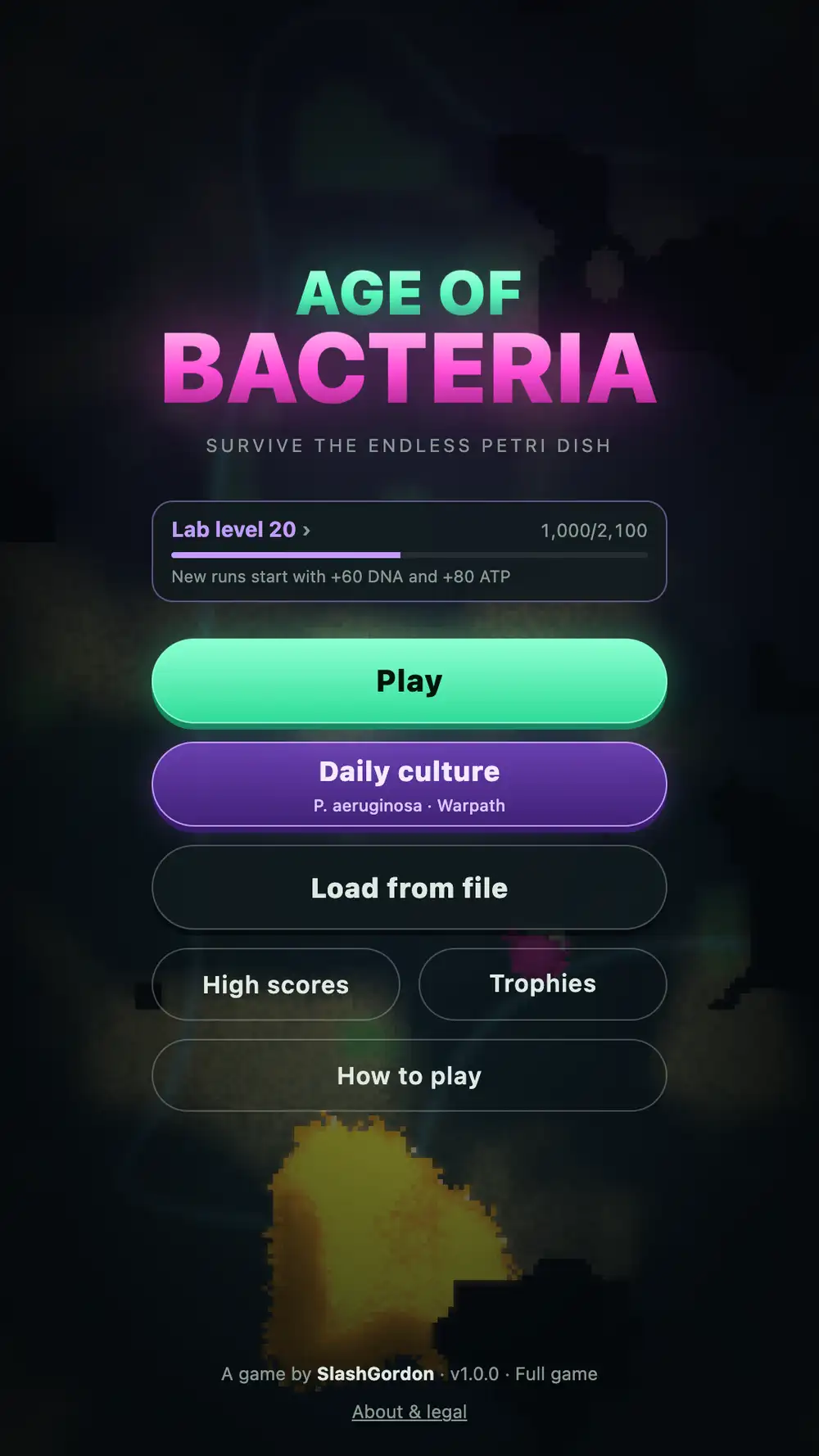
Title screen 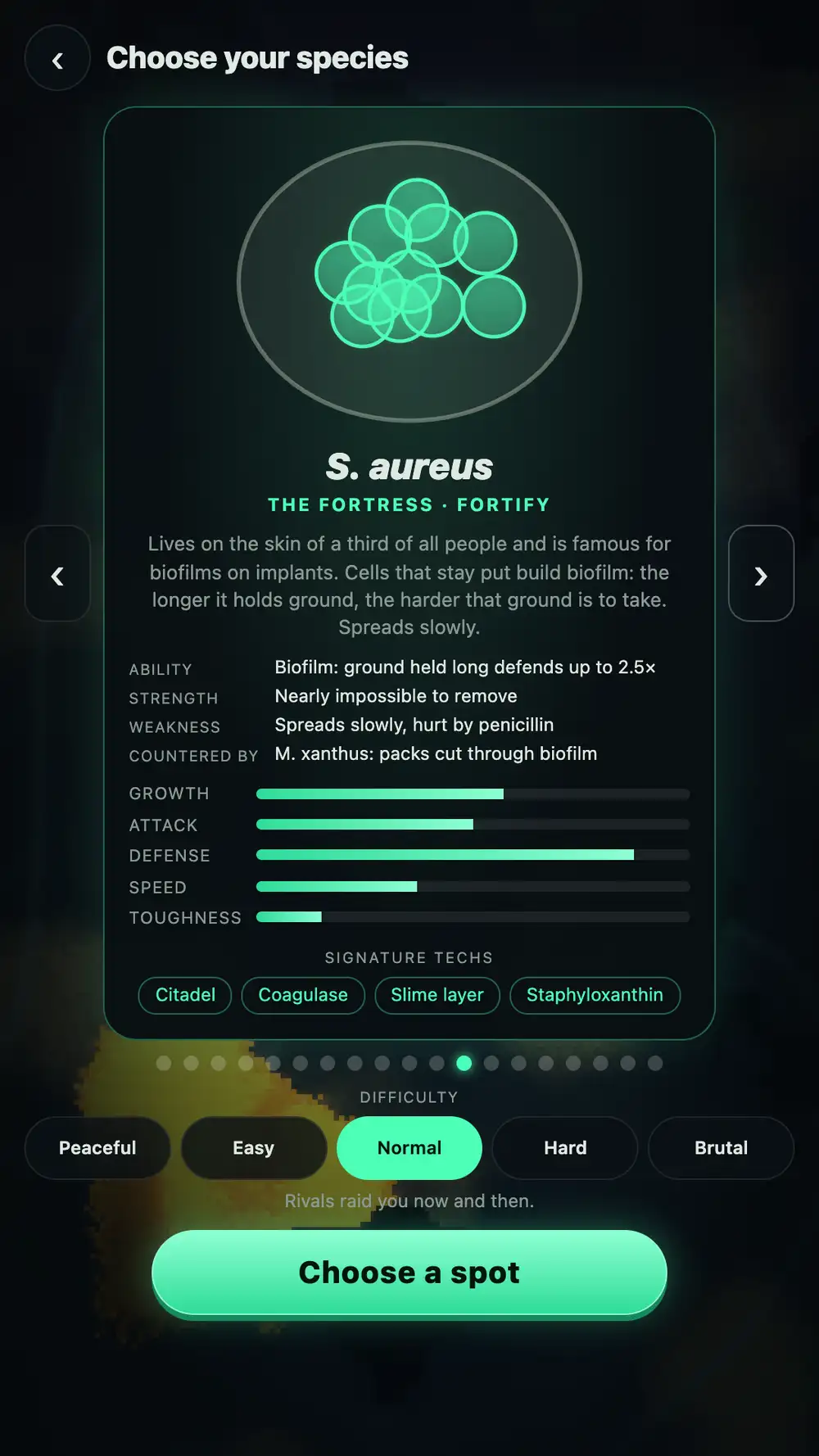
S. aureus builds biofilm walls 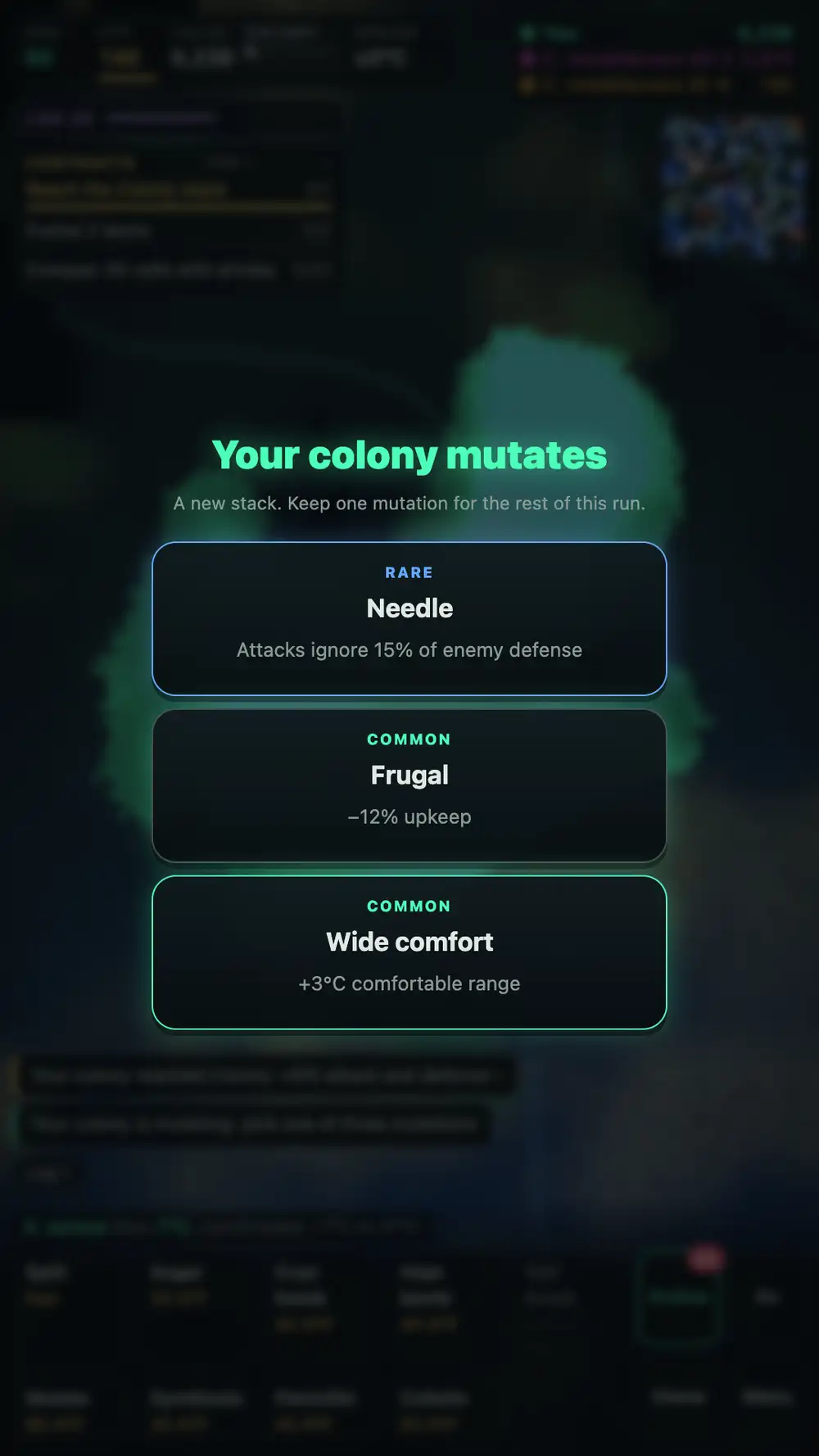
Pick one of three mutations 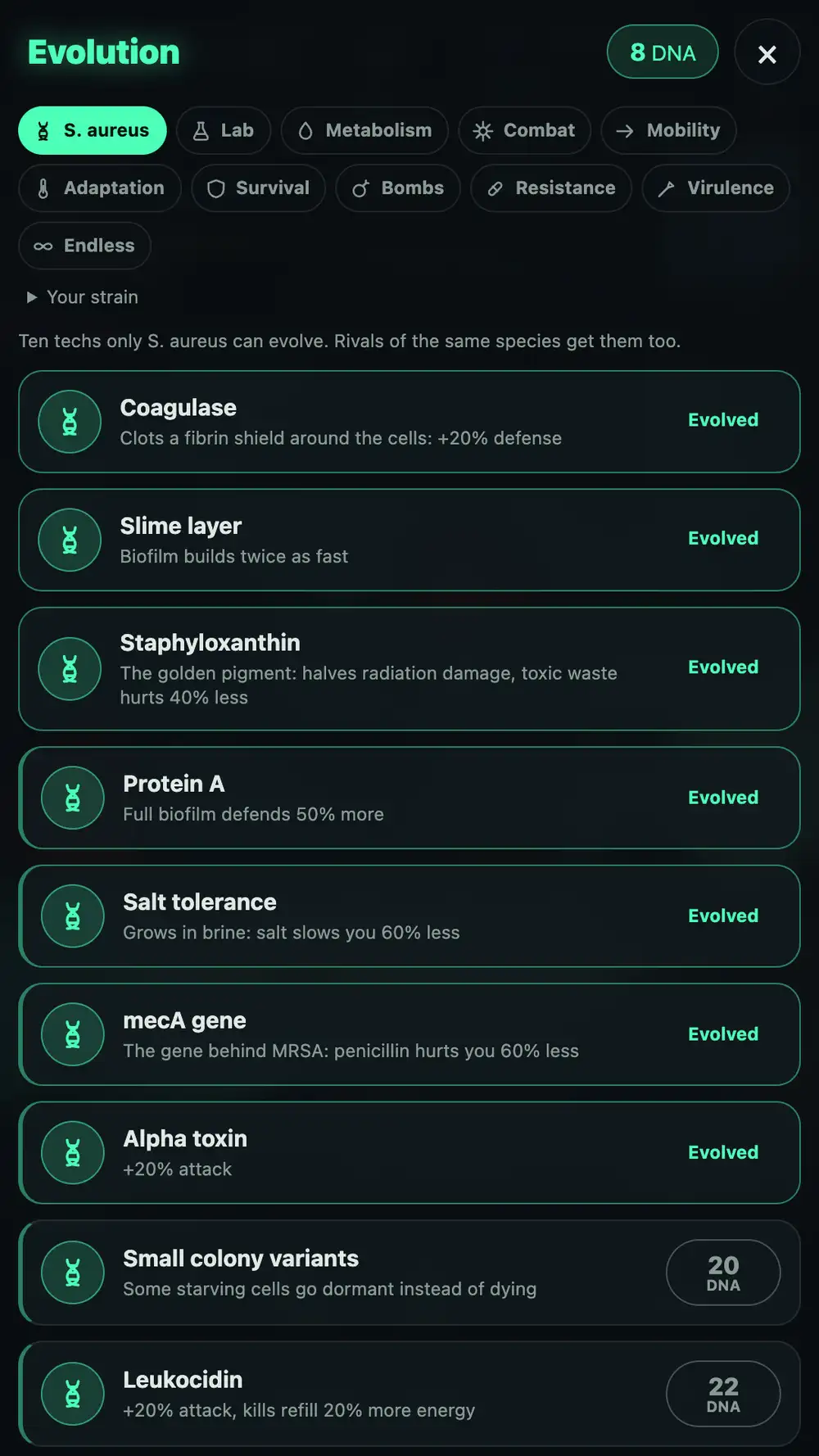
Ten techs only this species has
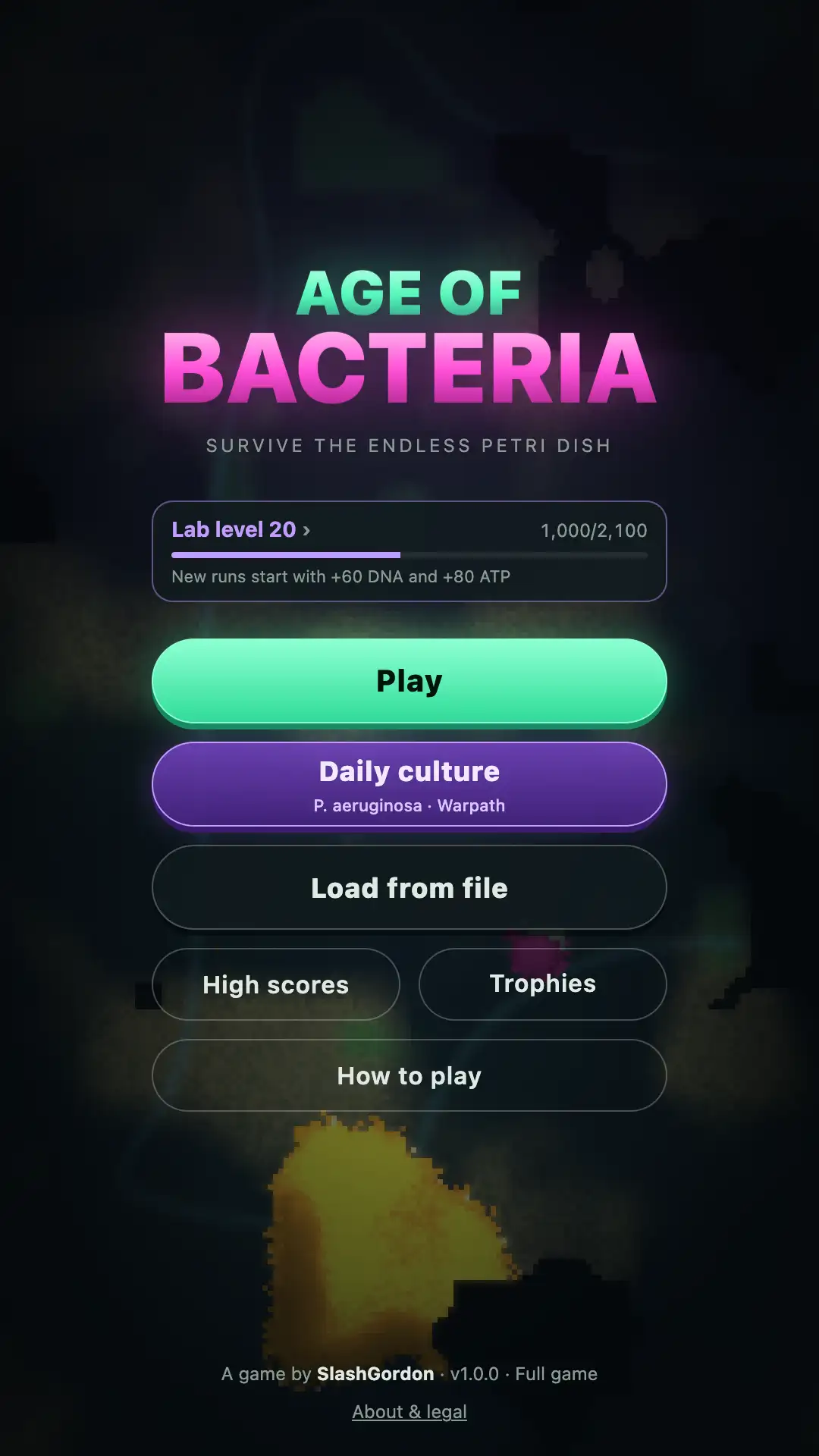
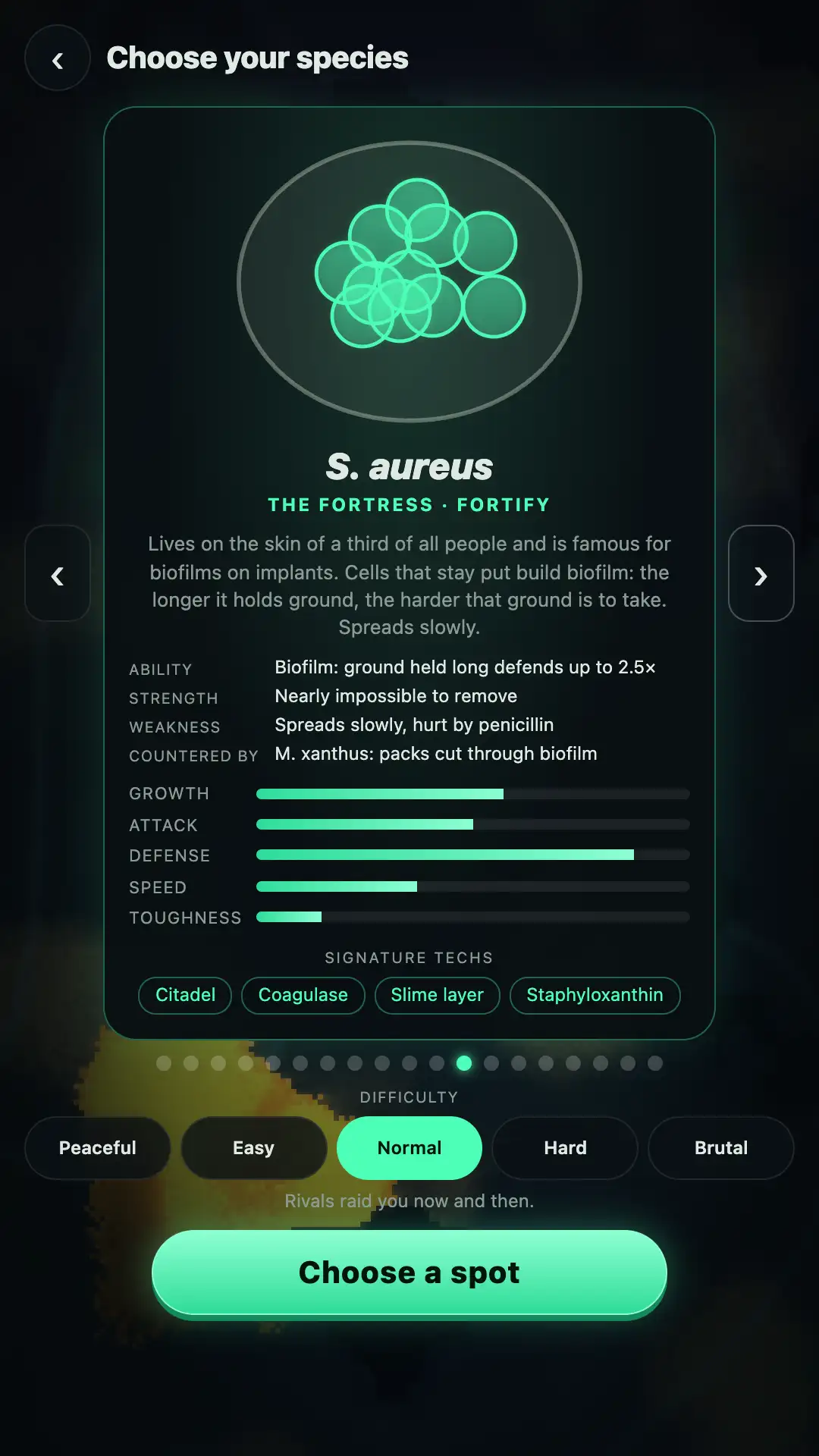
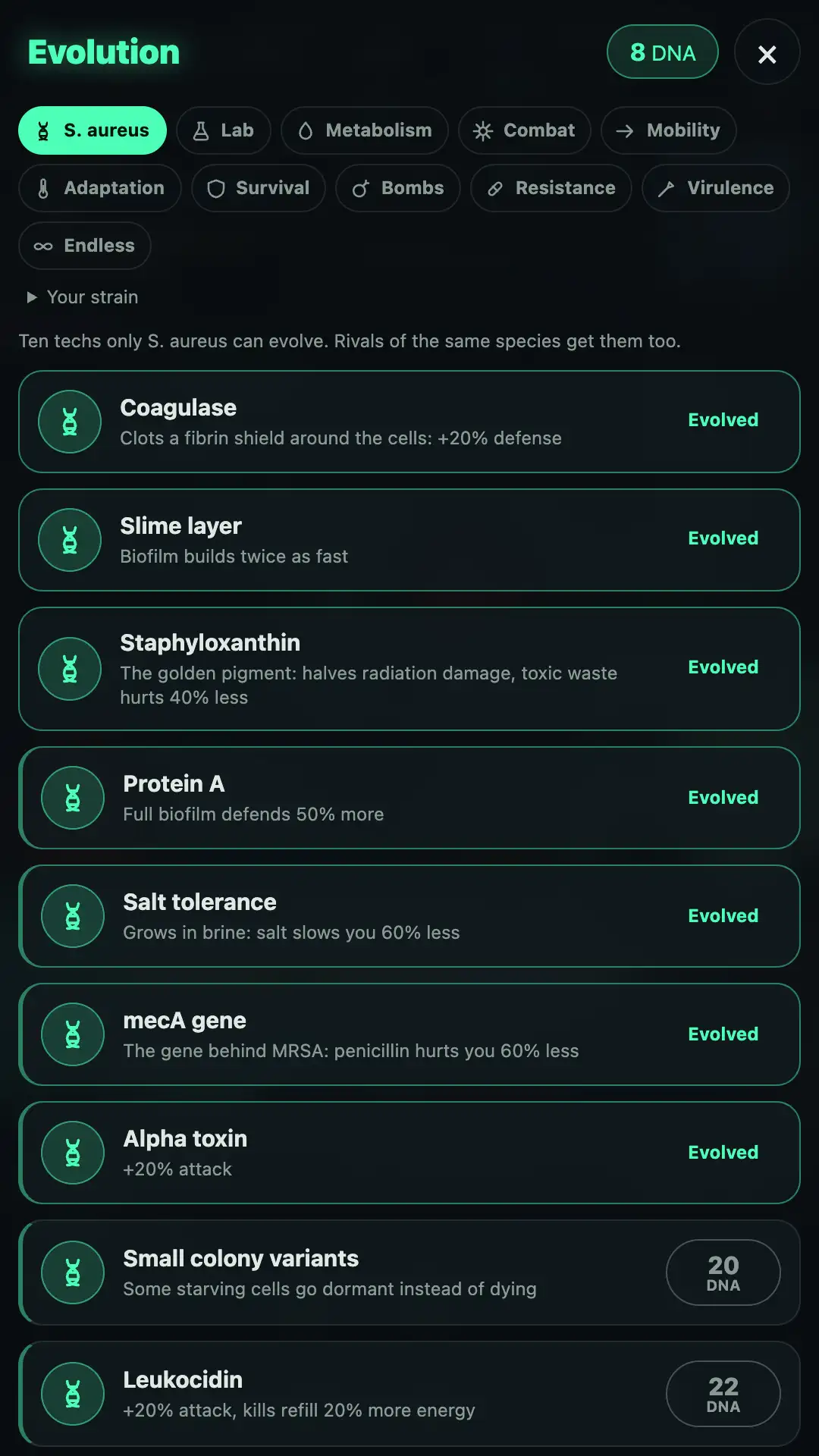
There are 19 species, each modelled on a real bacterium. E. coli adapts to heat, cold and pH. B. subtilis turns into spores when it starves. S. aureus builds biofilm walls, M. xanthus hunts in packs and H. pylori neutralises acid ground for good. The Gram stain decides which antibiotic hurts a strain: penicillin kills Gram-positive strains, colistin Gram-negative ones. So before you drop a drug on a rival, check what it is.
An endless world on a phone
The map has no edge, and the rivals keep growing and dying while you look elsewhere. Only the part on screen gets the full simulation. The world is split into 64×64 chunks and each chunk is in one of five states:
| State | Where | Cost |
|---|---|---|
| Hot | On screen plus one chunk, or holding an army | Every cell, every tick |
| Warm | The ring around the screen | Every cell, every other tick |
| Frozen | Just beyond that | Nothing, kept for 25 seconds so panning back is instant |
| Abstract | Further out | About 300 bytes per chunk |
| Pristine | Never touched | Nothing, rebuilt from the seed |
Abstract chunks run a statistical version of the cell rules: logistic growth toward the food the chunk can carry, starvation crashes and Lanchester-style fights between strains. When the camera comes back, the chunk is rebuilt from the seed and each strain’s head count grows back as a ragged blob around its stored centre. Rival empires keep expanding and collapsing out there, and new strains appear and show up on the minimap.
The game is plain JavaScript on a canvas, with no build step and no dependencies. The Android app is a Capacitor WebView around the same files. Saves go to IndexedDB as raw byte planes: in a test world with 83 full chunks an autosave took 5 ms, against 98 ms for the old JSON format.
Free version and full game
Age of Bacteria is on Google Play and itch.io. The free version has E. coli and Streptococcus on Peaceful, Easy and Normal. A one-time in-app purchase unlocks the other 17 species, Hard and Brutal, and the endless upgrades. The game runs offline, has no ads and collects no data. The details are in the privacy policy.
Second Place on Rankinpublic
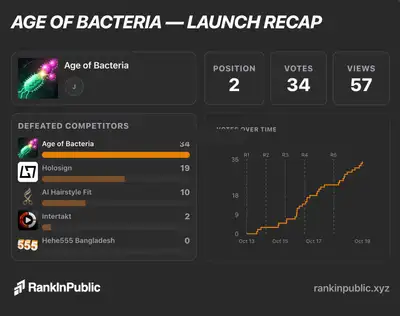
By the way, my launch on Rankinpublic landed in second place. Not bad at all! 😄